
The models: CarMind R.E.V and E.V#
Both boards carry two on-board models. CarMind E.V is fixed and tested. CarMind R.E.V keeps learning in your car: the board updates part of the model from what your car reports while you drive. The inputs, outputs and files of each are in Model files, and the scores in Model results.
Choose your model#
CarMind E.V |
CarMind R.E.V |
|
|---|---|---|
Status |
released in 2.4.0, the default in the 2.5.1 release |
new in 2.5.0, improved in 2.5.1, the default on a new board with the firmware from |
Size on the chip |
about 89 KB |
about 66 KB |
Parameters |
38,679 |
19,815 |
Time per run on the ESP32-S3 |
about 3.5 ms in the car, 2.9 ms on the bench |
about 2.9 ms in the car (median), 2.2 ms on the bench |
Learns in your car |
the model is fixed. The tank size and fill-up calibration learn with either model |
its fuel estimate and an airflow constant that also gives the engine size, so its torque estimate learns your engine too. Plus the tank size and fill-up calibration, like E.V |
Steady cruising with your foot on the gas |
can be shown as braking |
corrected in 2.5.1 |
Fill-up calibration |
yes |
yes |
Best for |
a fixed, tested model |
older cars, roughly pre-2020, that have no fuel-rate PID and can lose the airflow (MAF) reading |
On the ESP-Mosaico (OpenCarMind EdgeOS 2.1.0, as in 2.0.0 and mossREV 1.2.0) |
included, switch in Settings > MODEL |
included, the default on a new board |
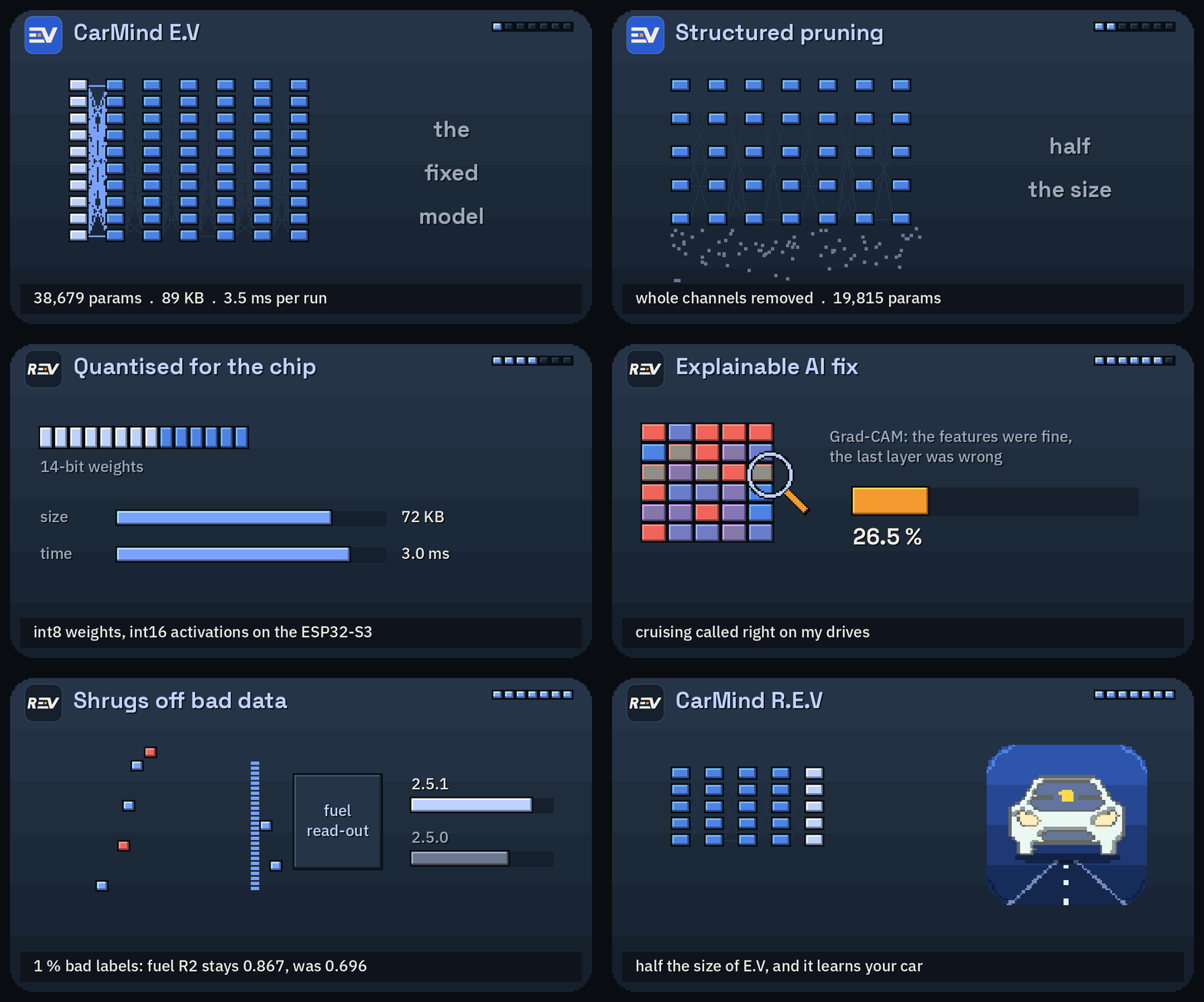
From E.V to R.E.V in seven steps, each with the number it moved. How each was measured is in the detailed README.
Many older cars do not report their fuel rate, so the board works it out from the airflow sensor. When that reading is missing, a fixed model can only offer its factory estimate. R.E.V learns your car while a fuel-rate or airflow reading is there and uses what it learned when it is not.
To switch, connect the board to the desktop app with its USB cable while the car is parked, open the Board page and pick the model under “On-board model”. The board keeps the choice after a restart, and what R.E.V learned stays on the SD card while E.V runs. More in What R.E.V learns.
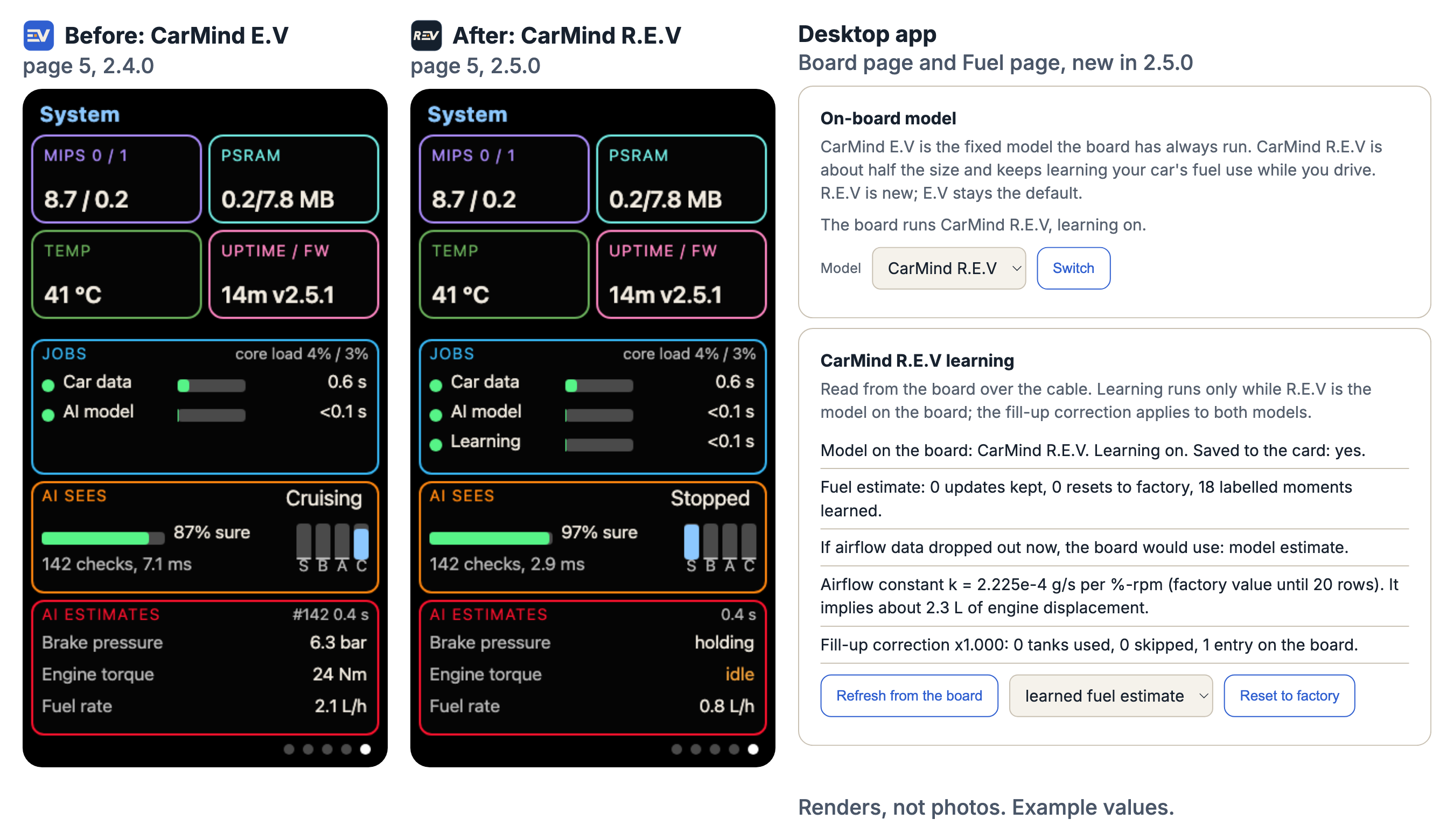
Renders, not photos, with example values. Left: page 5 with E.V. Middle: page 5 with R.E.V, which adds a third job, “Learning”. Right: the model selector on the app’s Board page and R.E.V’s learning status on its Fuel page.
What the models do#
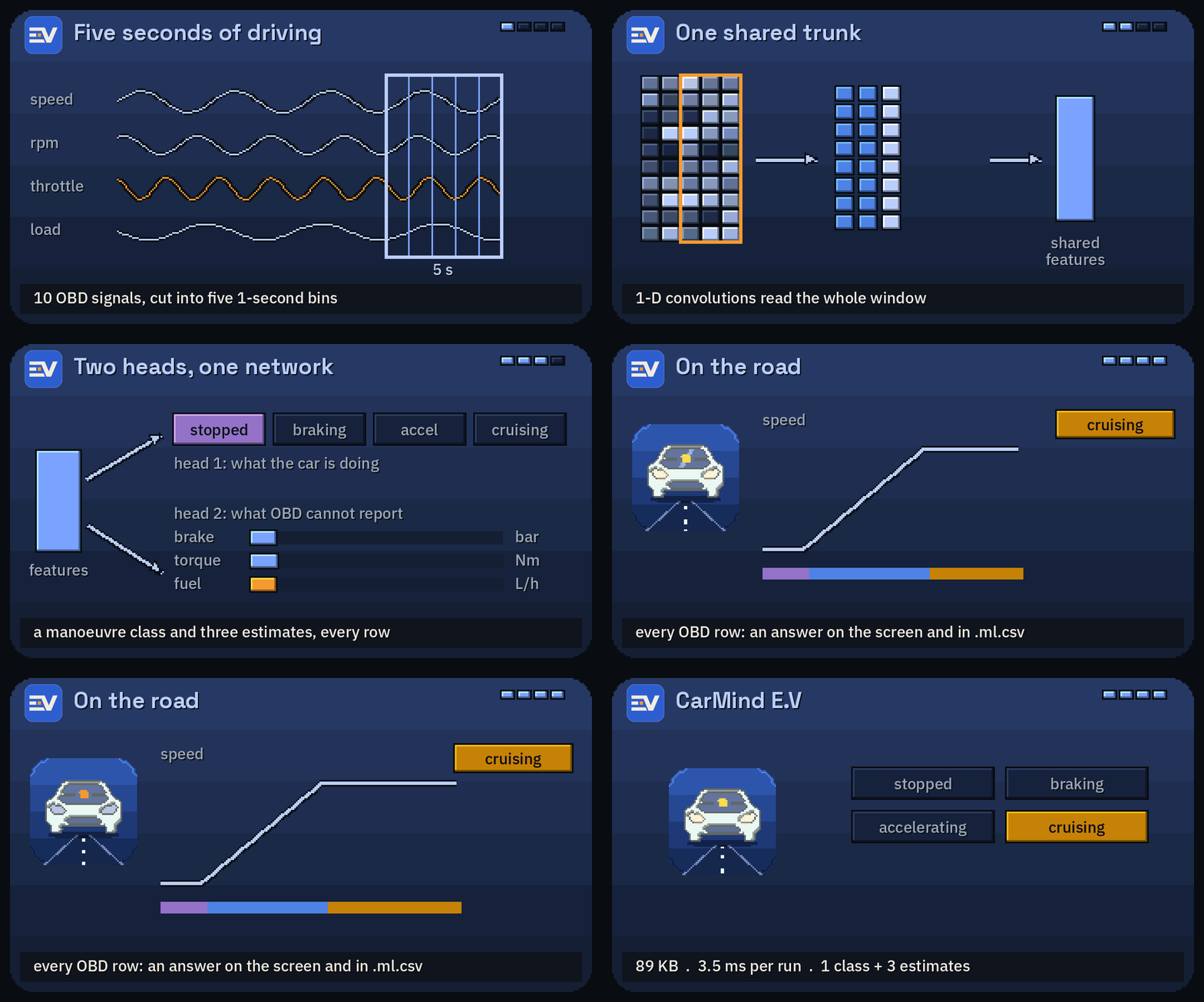
Both models are small quantised 1-D convolutional networks run by ESP-DL[6]: 8-bit weights and 16-bit activations, which makes them small and fast enough for a microcontroller. With every OBD row the selected model classifies the last 5 seconds and estimates brake pressure, flywheel torque and fuel rate. They were trained on public data, the HCRL Driving Dataset[7] and the Vehicle Energy Dataset[8], plus drives from my own car. Scores on held-out drives and unseen cars are in the detailed README.
The model card puts every step from E.V to the final R.E.V in one table: size, speed, classifier and fuel-learner scores, before and after, with a key to each metric and where it was measured.
How the models are made#
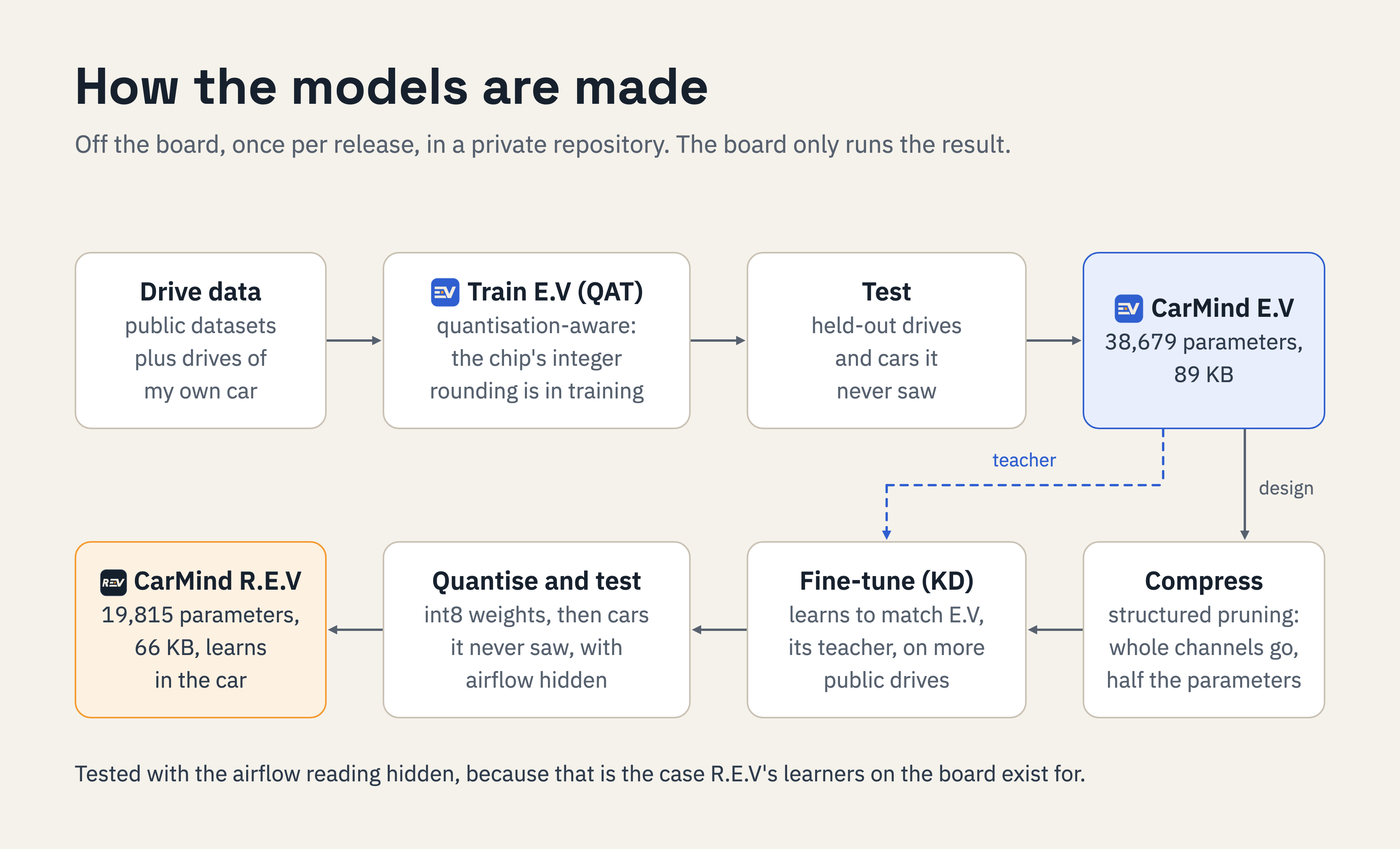
E.V is trained so that the version on the chip scores like the one on a computer. R.E.V starts from E.V’s design, is pruned to about half the parameters, and learns from E.V as its teacher on a wider set of public drives. The training code and data stay in a private repository. The shipped files are in ml/onboard and ml/onboard/rev, and docs/MODEL.md lists their inputs and outputs.
What R.E.V learns#
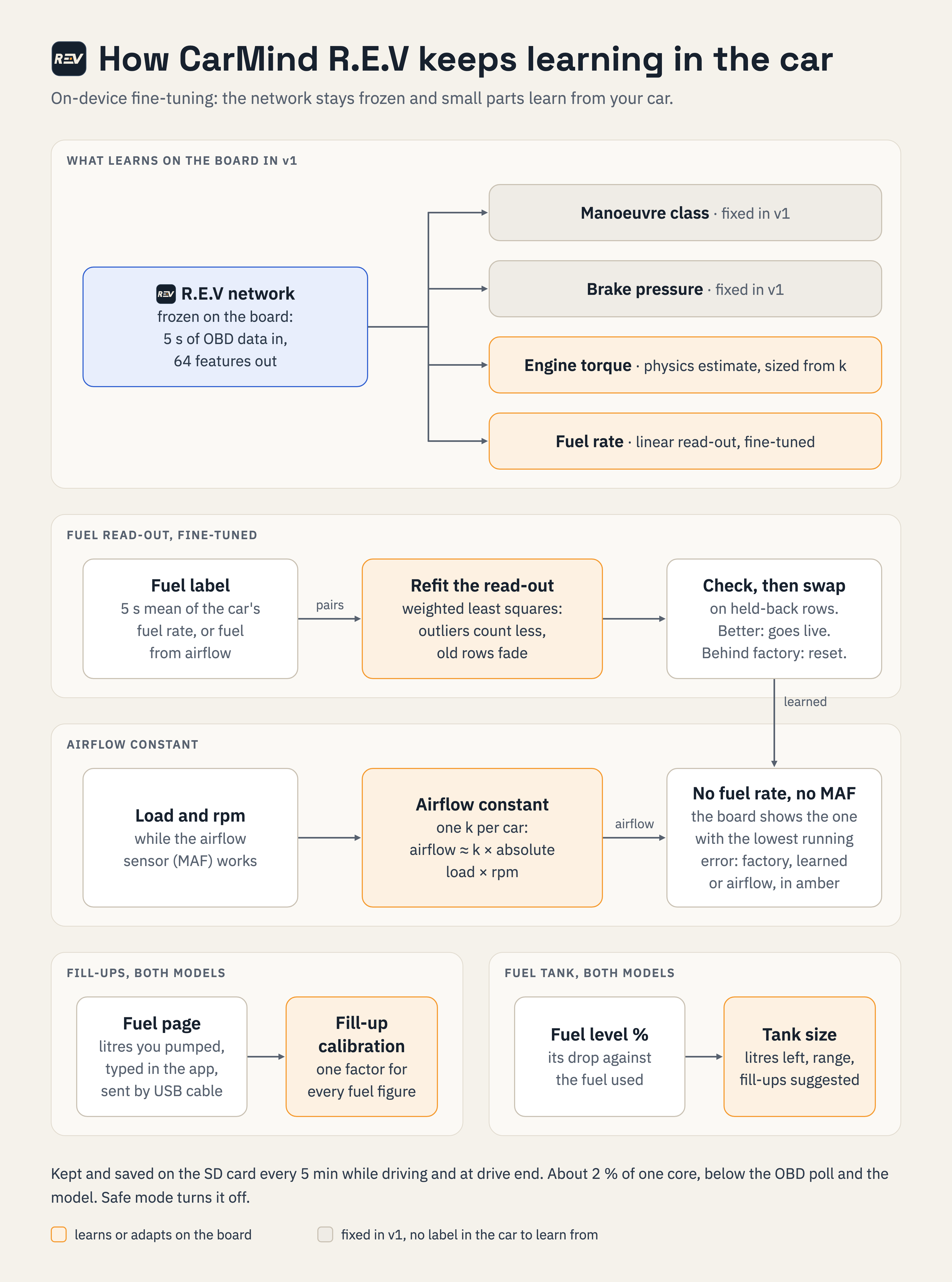
The network itself never changes in the car, which protects it from forgetting what it learned in training[9]. Small parts on top of it learn, each only from something the car gives it to check against.
Output |
In the car |
Learns from |
|---|---|---|
Fuel rate |
learns |
the car’s own fuel rate, or fuel worked out from the airflow sensor |
Airflow constant (also the engine size) |
learns |
airflow, engine load and rpm while the airflow sensor works |
Fill-up calibration, both models |
learns |
the litres you pump, entered in the app |
Fuel tank size, both models |
learns |
the fuel used against the drop in the fuel level |
Engine torque |
learns, through the engine size |
the energy in the fuel minus friction, using the engine size R.E.V learns. Planned: a learned torque read-out on cars that report torque (see Limitations) |
Manoeuvre class |
fixed |
nothing yet: the car gives no label for it |
Brake pressure |
fixed |
nothing: no car reports it |
How R.E.V learns on the board#
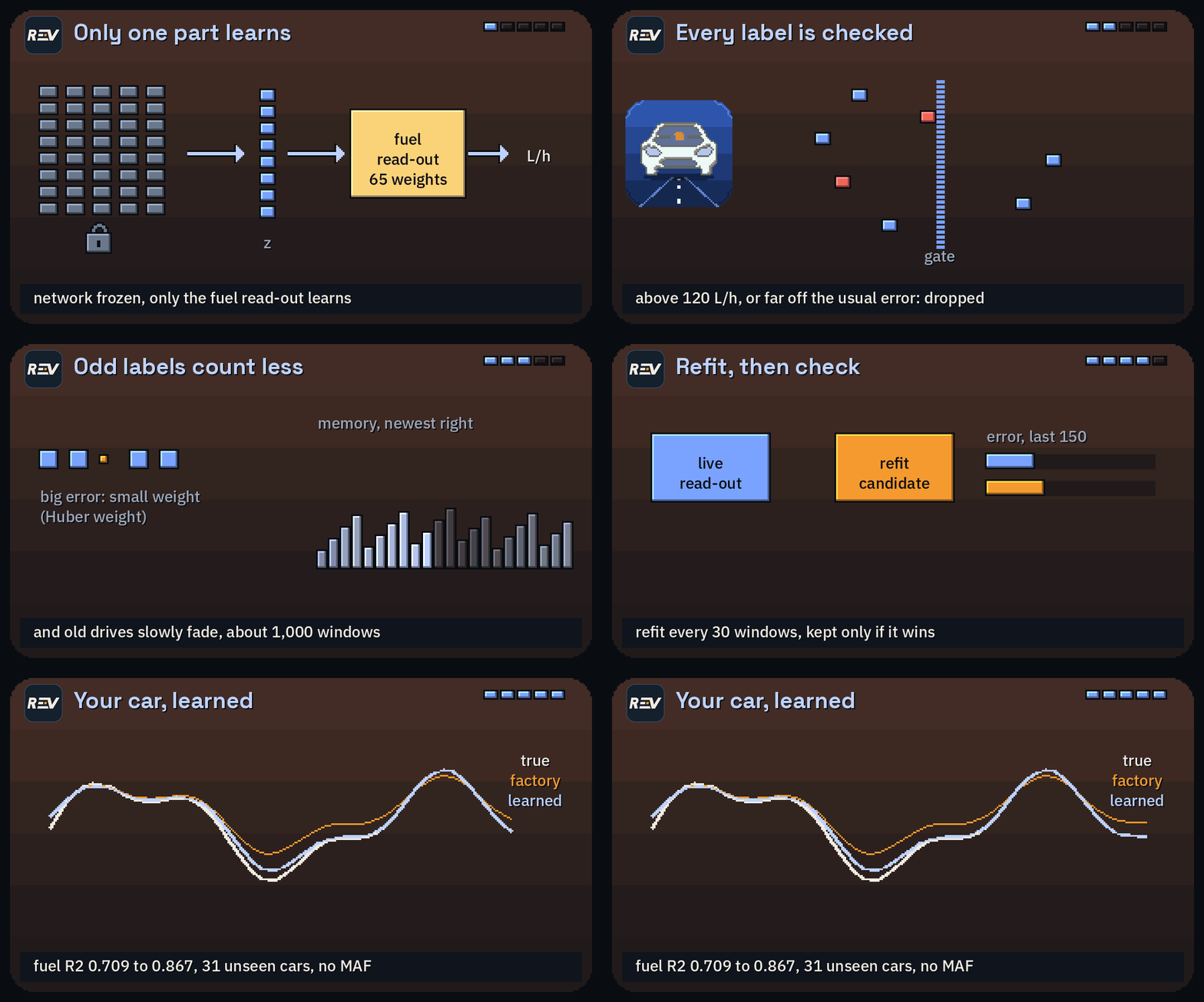
The last layer, which turns the network’s features into a fuel rate, is refit from your car’s own readings. A refit goes live only if it beats the current one on recent driving, and the board goes back to the factory version if learning ever makes things worse. Since 2.5.1 the learner ignores implausible readings and gives less weight to unusual ones[10], so a faulty sensor cannot spoil what it learned. When the car reports neither fuel rate nor airflow, the board uses whichever estimate has been most accurate on your car so far and shows it in amber. What R.E.V learned is saved to the SD card while you drive.
Looking inside R.E.V with explainable AI#
On R.E.V’s first drives in my car, the screen said “braking” while I held a steady speed with my foot on the gas. E.V does the same. I opened up R.E.V with explainable-AI methods, Grad-CAM[11] and a probe on its internal features, and found that the network’s features already told cruising from braking. Only the last layer that picks the class had it wrong. Correcting that one layer fixed it, and everything R.E.V had already learned in the car stayed valid.
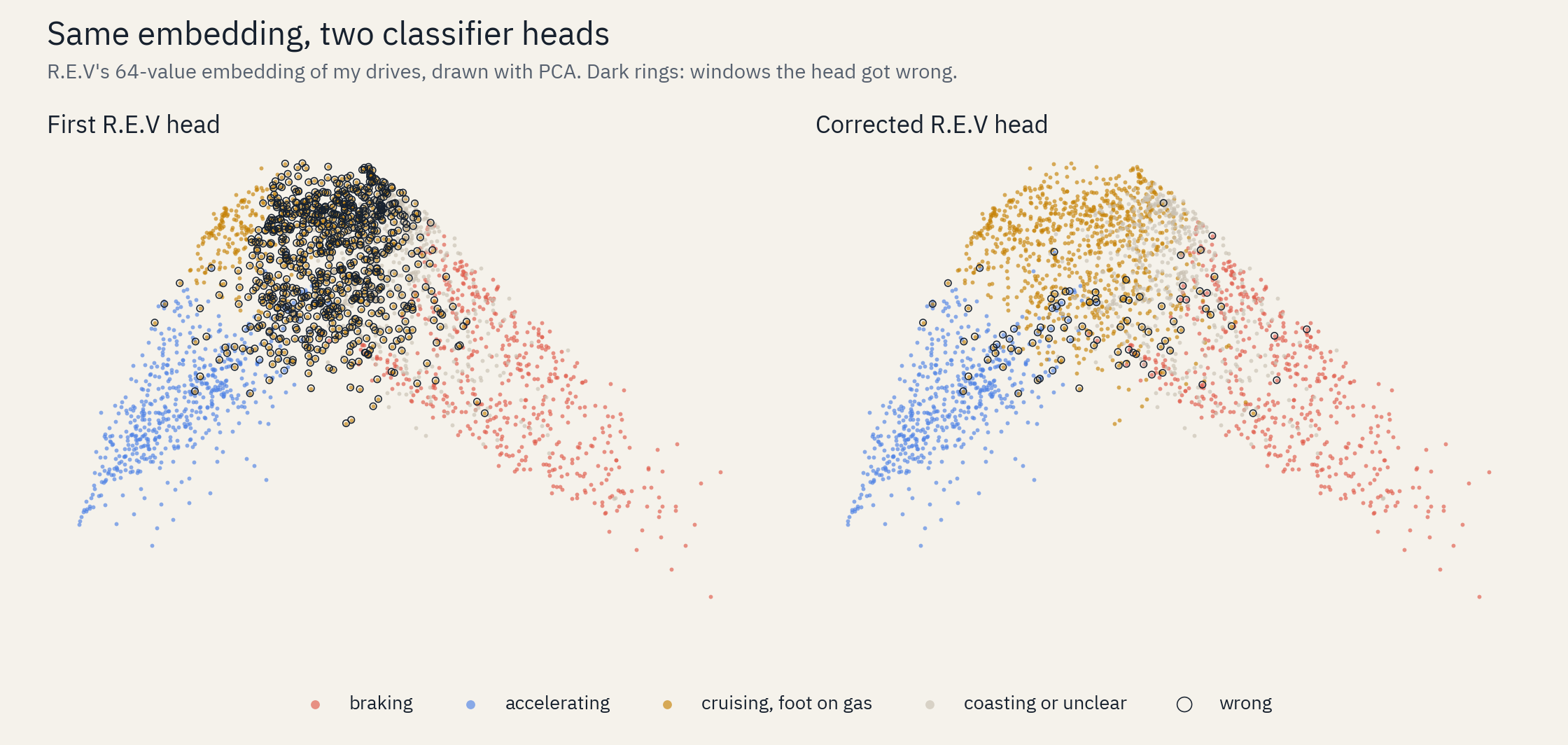
Each dot is a 5-second window of my driving, placed by what the network sees. The points are the same on both sides. Only the layer that reads them changed. The Grad-CAM maps and the scores are in the detailed README.
How R.E.V got better, step by step#
2.5.0. R.E.V ships: half of E.V’s size, and it learns your car’s fuel use, airflow and tank in the car.
First drives. The learners worked, and the classifier called steady cruising “braking”.
Explainable AI showed the error was in the classifier’s last layer, not in what the network sees.
A corrected last layer fixed it without touching what R.E.V had learned.
Fault tests showed that a few bad sensor readings could stop the fuel learner.
A fuel learner that shrugs off bad readings, checked on public cars and against two published meta-learning methods. It came out ahead, so it ships in 2.5.1.
The numbers for each step are in the detailed README.
Edge learning: R.E.V picks what to learn#
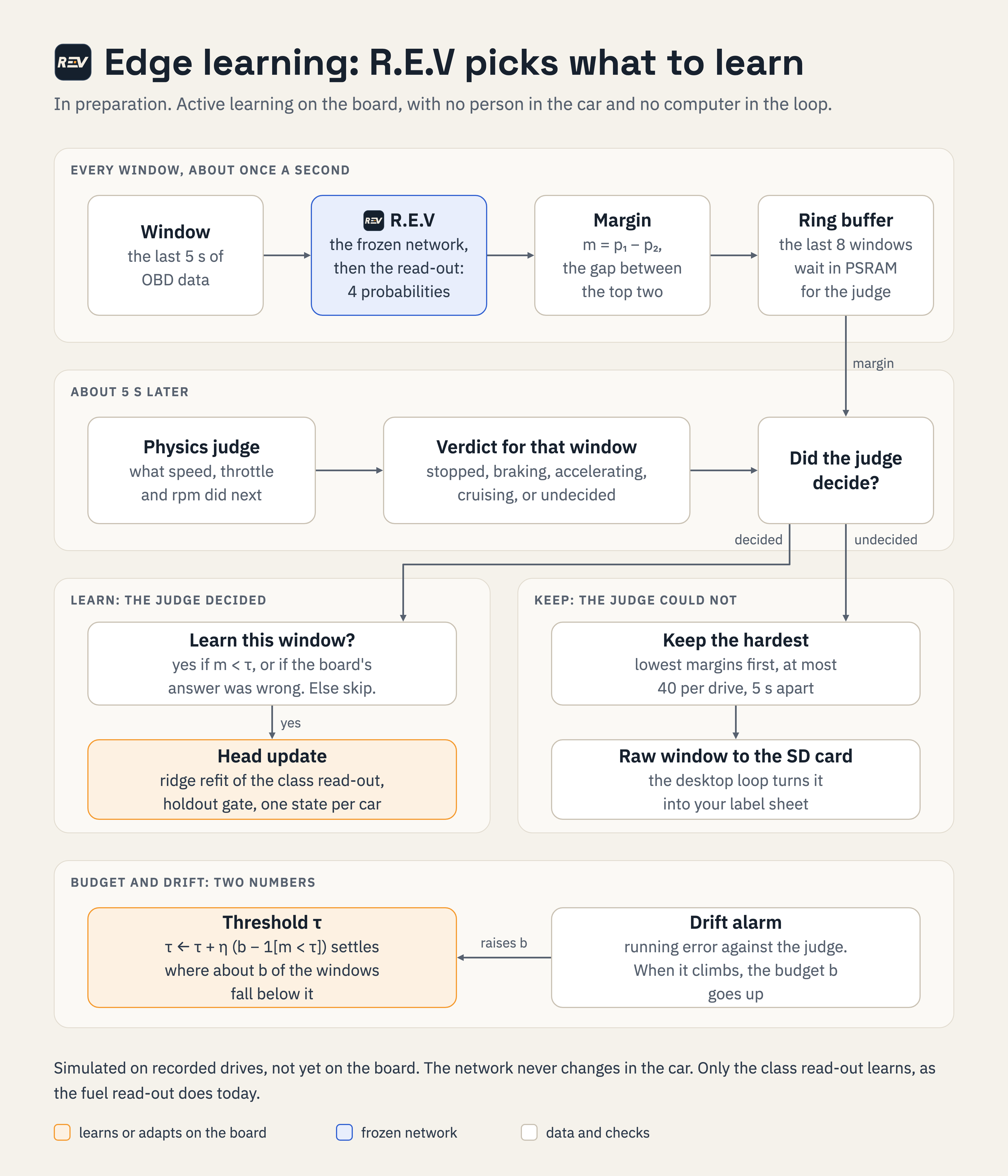
R.E.V’s classifier does not learn in the car yet. Edge learning is how I plan to change that, and I am preparing it now. It is active learning that runs on the board itself: the board decides which windows are worth learning from, and which few are worth your time later. Nobody in the car labels anything, and no computer takes part while you drive.
The phrase “edge learning” already exists as a broad term for training models on edge devices[15]. Here I use it as the name for one specific method, four rules built for a microcontroller whose teacher is free, late and sometimes silent.
The teacher is a physics judge. About 5 seconds after a window, what the speed, throttle and rpm did next usually shows whether the car was stopped, braking, accelerating or cruising. Sometimes it cannot tell, and the window stays undecided. ESP-DL runs the network but does not train it[6], so the learning happens in the class read-out, refit by least squares in C, the way the fuel read-out learns today.
The four rules:
Score every window by its margin, m = p₁ − p₂, the gap between the two highest class probabilities. A small gap means R.E.V is torn between two answers, most often braking and cruising. Margin is a standard active-learning score[16], and the board already logs the probabilities in every
.ml.csvline.Keep the learn rate on budget with a threshold that moves itself, \(\tau \leftarrow \tau + \eta\,(b - \mathbf{1}[m < \tau])\). Here b is the share of windows to learn from, η is a small step, and the indicator 1[m < τ] is 1 when a window’s margin is under the threshold. If the board learns too often, the indicator is 1 more than b of the time and τ shrinks. If it learns too rarely, τ grows. It settles where a share b of the margins fall below it. This is Robbins–Monro stochastic approximation[17] with a constant step, so τ keeps following the margins as the car or the driving changes. Žliobaitė et al. move an uncertainty threshold after every decision in a similar way for drifting data streams[18], with a multiplicative step and no target rate. The rule stores two numbers.
Learn from a window when its margin is under τ, or when the judge’s verdict shows the board was wrong. The update is a ridge refit of the class read-out, with a holdout gate and one saved state per car, like the fuel learner.
Keep undecided windows by margin. These are the only windows where a label costs anything, because a person has to give it. The board will write up to 40 per drive to the SD card, at least 5 s apart because windows overlap, and the desktop tools turn them into a label sheet.
To test the rules before writing them for the board, I copied the board’s read-out learner into Python and streamed seven drives from a second car, one R.E.V never trained on, in the order they were driven. It started from the shipped R.E.V. Each window was scored first and learned from afterwards, so no window graded a model that had already seen it.
Rule, at a 10 % learn budget |
Judged windows learned |
Macro recall over the stream |
|---|---|---|
No learning |
0 % |
0.857 |
Learn every judged window (stopped ones 1 in 10, as on the board) |
56 % |
0.954 |
Random, 5 seeds |
5.8 % |
0.935 ± 0.008 |
Margin only |
5.5 % |
0.944 |
Margin or mistake (edge learning) |
5.7 % |
0.953 |
Margin or mistake matched learning from every judged window while learning from about a tenth as many, so the board runs the solver about ten times less often. Two cautions. This is one stream of seven drives with one run of each margin rule, so the gap to random is about two standard deviations. That is a good sign, not a settled result. And a read-out adapted to the new car scored lower on other cars’ validation windows, KIA from 0.778 to 0.728 and my car from 0.969 to 0.935. One saved state per car is there so that this adaptation never reaches another car’s read-out.
Three ideas of mine failed, and each was meant to be the new part:
Posterior flip probability. A ridge read-out is a Bayesian linear model, so I computed in closed form the chance that a read-out drawn from its posterior would change the board’s answer. At ranking the board’s real mistakes it scored an AUROC of 0.874, against 0.942 for plain margin. The mistakes here were systematic, such as a throttle that reads high at idle, not windows the read-out was unsure about.
A loss predictor after Yoo and Kweon[19], trained on the board by the judge’s late verdicts. AUROC 0.908, still below margin.
Learning only from high-loss windows, which are mostly the board’s mistakes. At a 5 % budget it reached 0.927 against 0.943 for margin. A learner that sees mostly its own errors gets a skewed sample, the sampling bias Dasgupta describes for active learning[20].
Status: the rules run in simulation only. The board code, the buffer in PSRAM and the drift alarm are not written, and none of this is in the firmware on main.