
OpenCarMind documentation#
OpenCarMind is an open-source OBD2 logger and dashboard for the ESP32. It reads your car through a Bluetooth LE OBD-II adapter, runs small neural networks on the chip and keeps every drive on the board’s own storage. It needs no phone, no account and no internet connection.
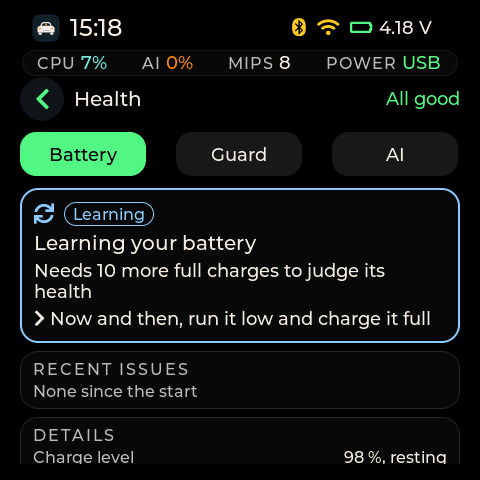
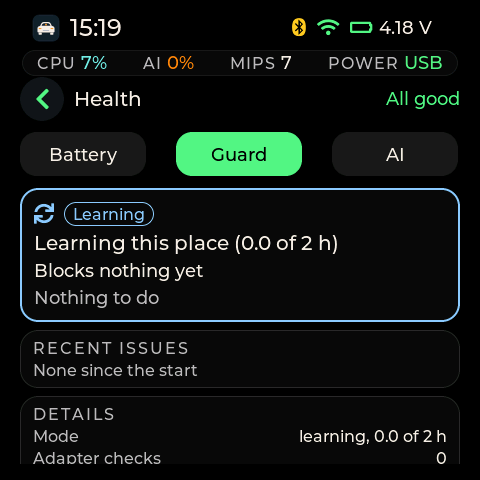
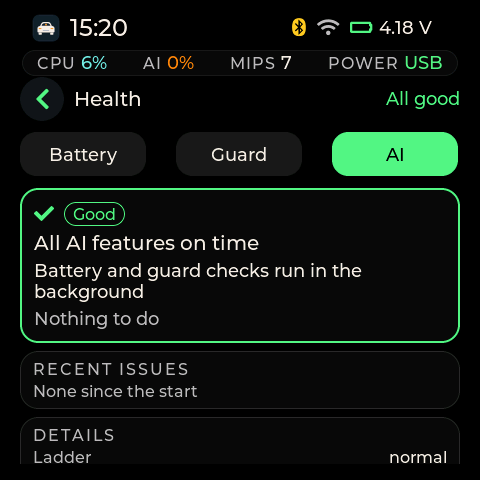
The Health app of OpenCarMind EdgeOS 2.1.0, captured on the ESP-Mosaico after a fresh start: the battery still learning, the guard learning the place, every AI feature on time.
Two boards, one source tree#
Waveshare ESP32-S3-LCD-1.47B, a 1.47 inch LCD and an SD card for the drives.
Firmware: OpenCarMind 2.5.1. Beta: 2.5.1b, a pre-release not yet checked on an S3 board as a whole.
Espressif ESP-Mosaico V1.2 (ESP32-S31), a 480 × 480 AMOLED touch screen and a 128 MB NAND for the drives.
Firmware: OpenCarMind EdgeOS 2.1.0, with the Health app for the battery and the radios.
Quick links#
What you need, flashing, pairing the adapter and the first drive.
The S3 image and the ESP-Mosaico image, and how each one is written.
Import drives over USB, switch the model, add fill-ups.
Firmware images, the desktop app installers and the checksums on GitHub.
What OpenCarMind is#
OpenCarMind is an open-source OBD2 logger and dashboard for the ESP32, with a pruned, knowledge-distilled multi-task 1D CNN that adapts its read-out on the device. Its newest firmware, OpenCarMind EdgeOS 2.1.0, is an AI-first operating system for the chip. It runs on FreeRTOS’s preemptive scheduler and treats every model as a soft real-time job with a deadline. A model is admitted only when every deadline on its core still holds, and when deadlines slip the board steps down in a fixed order (screen rate, then learning, then the model) so the drive log keeps running. Version 2.1.0 adds AI services that estimate the battery’s charge and health, check it for faults and guard Bluetooth and Wi-Fi, and a Health app that tells you in plain words what is wrong and what to do. OpenCarMind turns an ESP32 board and a Bluetooth OBD-II adapter into a car data logger that runs neural networks on the chip. It needs no phone, no account and no internet connection. Everything it records goes to the board’s own storage (an SD card on the ESP32-S3 board, the 128 MB NAND on the ESP-Mosaico) and, if you pair the board, to the desktop app on your own computer.
It ships two on-board models, and you choose between them in the desktop app. CarMind E.V is fixed and tested. CarMind R.E.V is my first model that keeps learning in your car: the board itself updates part of the model from what your car reports while you drive, with no computer or cloud in the loop.
Licence: MIT. Website: https://alveeerahman.github.io/OpenCarMind/. Documentation: https://buildforpeople.dev/docs/opencarmind/ (also on GitHub Pages). Two release lines, both built from this main:
ESP32-S3 board: OpenCarMind 2.5.1. The firmware and the desktop app for Windows, macOS and Linux are on the latest release. A beta, 2.5.1b, has the S3 firmware with every change on
mainsince 2.5.1. It is a pre-release, not yet checked on an S3 board as a whole.ESP-Mosaico: OpenCarMind EdgeOS 2.1.0. The board image is on the EdgeOS 2.1.0 release. Do not flash it on an S3.
The same firmware also runs on Espressif’s ESP-Mosaico touch-screen board. Its newest version, OpenCarMind EdgeOS 2.1.0, adds a small operating-system layer (a boot health check, refusals of risky changes while you drive, model admission by response-time analysis and battery protection) and, new in 2.1.0, AI services for the battery and the radios with a Health app to show them. User manuals for both boards are in docs/manual.
What you get#
Every standard Mode 01 field the car reports (70 are decoded), battery voltage, the VIN, and stored, pending and permanent trouble codes. One CSV row per poll cycle.
A small neural network on the chip. It classifies the last 5 seconds of driving as stopped, braking, accelerating or cruising, and estimates three values the OBD port does not report: brake pressure, flywheel torque and fuel rate.
A save to the SD card every 10 seconds and a power-off line on page 3: green “Safe to turn off” once everything is on the card, red with the reason otherwise. The drive ends by itself 15 seconds after the engine computer stops answering.
Fuel economy in km/L, or mpg in the US and the UK, from the best source your car has. A car that gives nothing shows “–”, never a made-up number.
Units that follow you. The first time the board joins Wi-Fi it reads the country of the access point and switches to miles and mpg in the US or the UK.
Fill-up calibration. Enter fill-ups in the desktop app, and the board corrects its fuel figures from what you actually pumped.
A fault engine that ranks trouble codes by severity and groups codes that share a cause.
Dark and light screen themes, by time of day or fixed.
A soft real-time scheduler that times every job against its deadline and restarts the board if a step hangs.
Optional Wi-Fi, for the clock only: one HTTPS request to one time server you can choose.
On the ESP-Mosaico, a Health app (OpenCarMind EdgeOS 2.1.0): the battery’s charge and health, a battery fault check and a guard for Bluetooth and Wi-Fi, each explained in plain words with what to do.
A desktop app for Windows, macOS and Linux that imports drives, charts them, shows fuel per drive, switches the model and takes your fill-ups.