Test drives#
Two additional drives serve as a held-out test set for the models on main. No model saw them during training or tuning.
Signals#
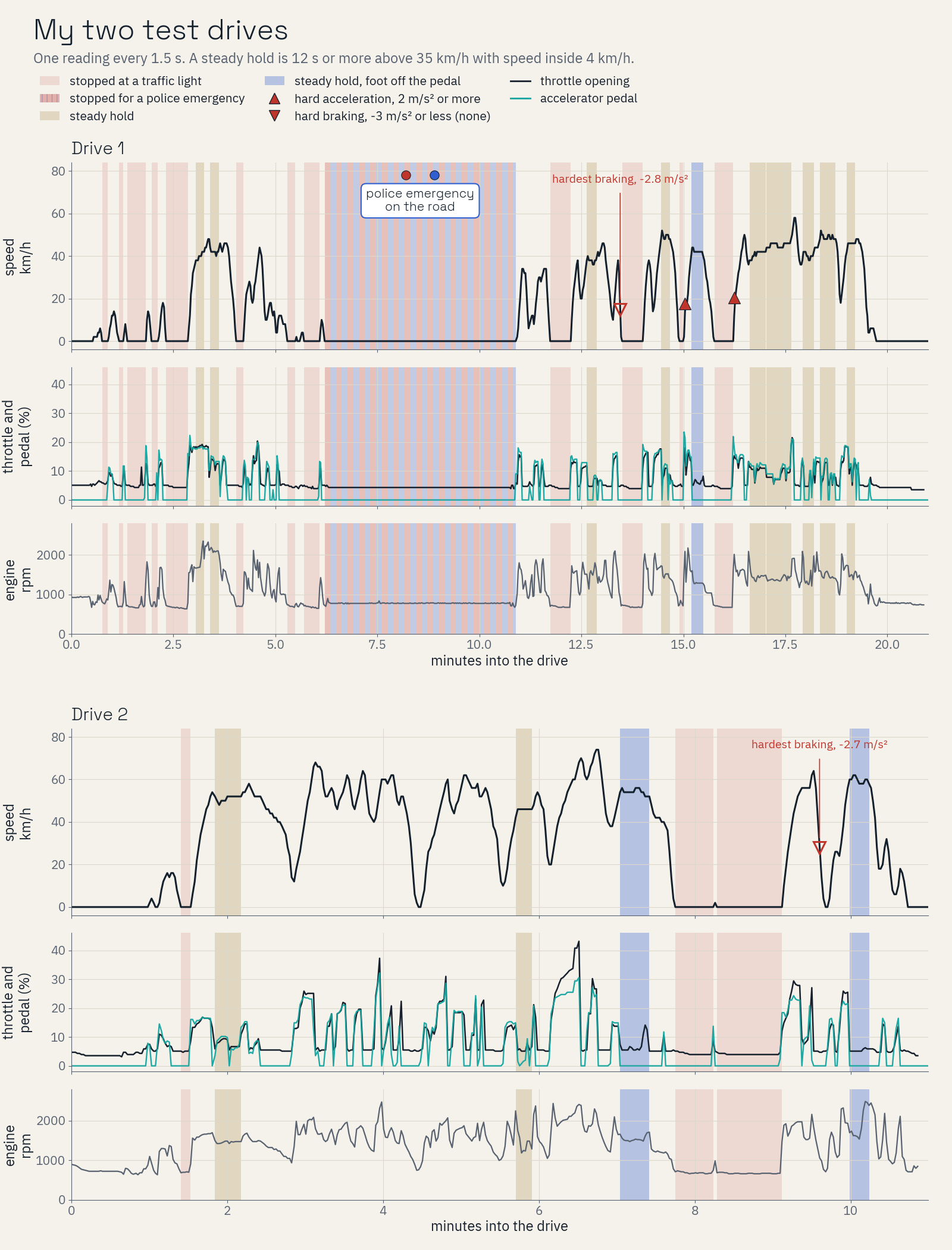
Speed, throttle, accelerator pedal and engine rpm over time. Red bands are stops at traffic lights, and the striped band is an extended stop for a road emergency. Sand bands are steady holds and blue bands are holds with the pedal released, as under cruise control. Triangles mark hard acceleration and hard braking.
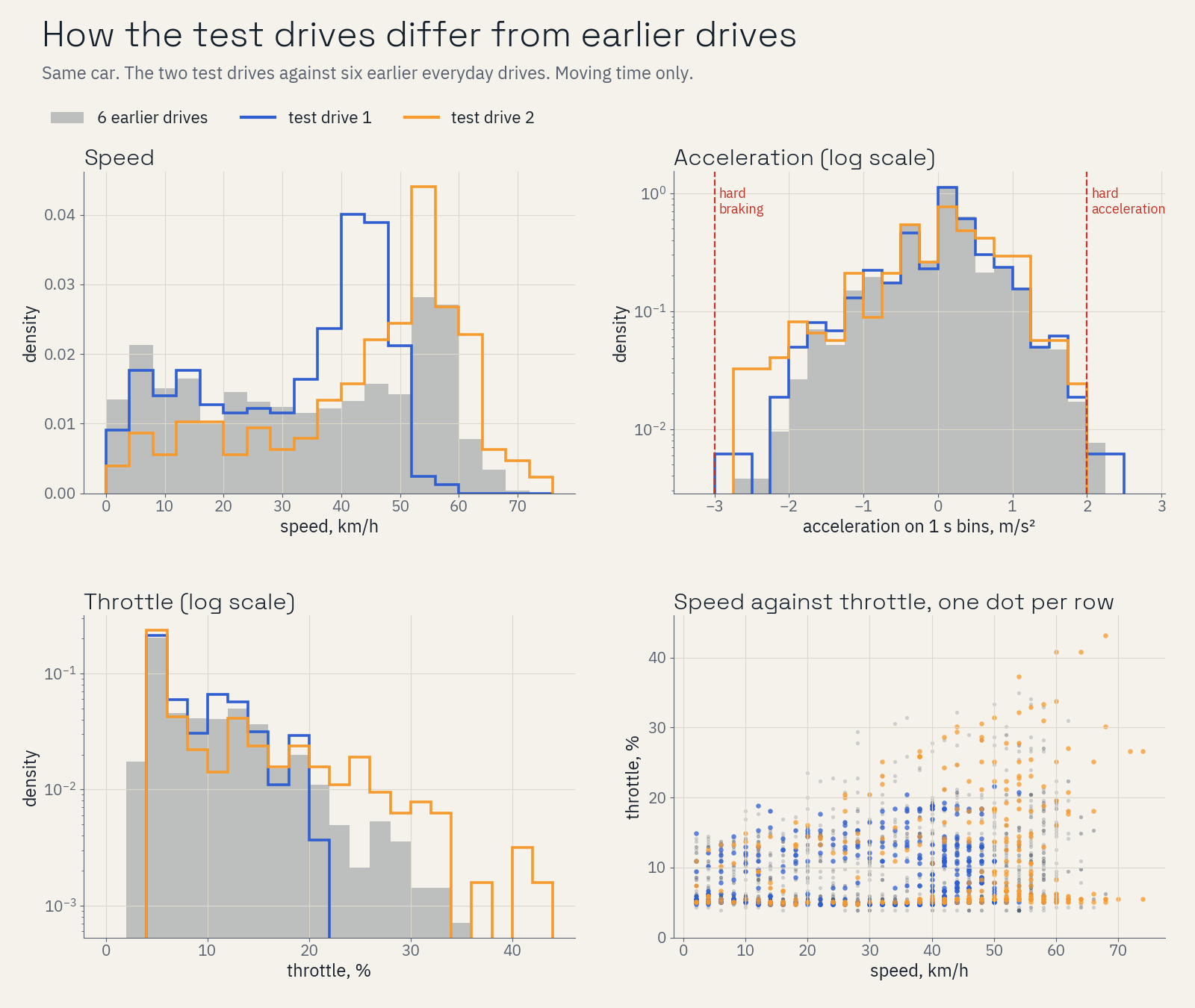
Distributions of speed, acceleration and throttle, and speed against throttle, for the test drives and six routine drives of the same vehicle.
Why the set is a fair test#
The drives move the inputs away from the routine data in five ways:
Extended idle. One stop is about three times longer than the longest stop in the routine drives, so the classifier must hold “stopped” over a long stationary stretch with the engine running.
Stop and go. Frequent stops at traffic lights, each followed by a launch.
Higher load and speed. One drive spends more of its moving time above 20 % throttle than any routine drive, and reaches a higher top speed.
Cruise control. With cruise control engaged, the throttle moves while the pedal reads zero. A model that relies on the pedal signal would misread these stretches.
Hard acceleration and braking.
Scoring#
The drives are scored as data from an unseen vehicle. No per-vehicle settings carry over from earlier drives: the closed-throttle level used for the labels is estimated from each drive, and every learner starts from its factory state. The models run as their published int8 files.